

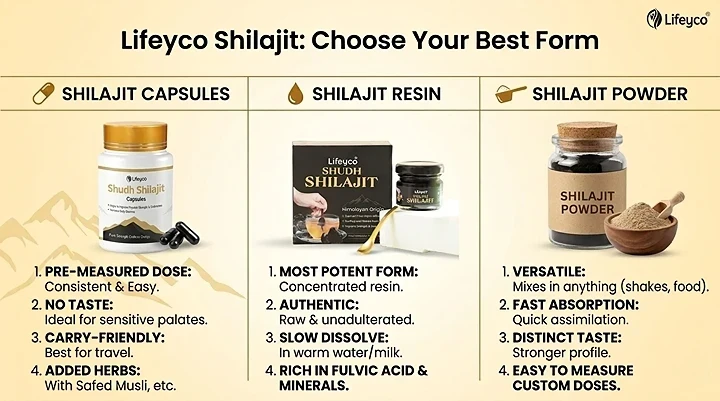
Shilajit Resin is the most potent and pure form — highest fulvic acid, best bioavailability, closest to nature. Capsules are the most convenient for daily use — pre-measured, no mess, travel-friendly. Powder sits in the middle — flexible dosing but less common. The best form depends entirely on your lifestyle, goal, and how consistent you can be. This guide gives you the full picture.
You decided to try Shilajit. Smart choice. But then you hit the product pages — and suddenly there are three completely different formats staring at you. Resin. Capsules. Powder. Every brand says their format is the most effective. So which one actually is?
Here is the truth: the form you choose has a real impact on how much benefit you get. The same raw Shilajit, processed differently, delivers different levels of fulvic acid content, different absorption rates, and different user experiences. And what works best for a gym-goer in his 20s is not necessarily right for a 45-year-old professional with a busy schedule.
In this guide, we compare all three forms honestly — on purity, bioavailability, processing, cost, and convenience — so you can make an informed choice without the brand noise.
What Is Shilajit and Why Does the Form Matter?
Shilajit is a naturally occurring, mineral-rich resin that forms over centuries deep inside Himalayan rock formations. Compressed plant matter decomposes at high altitude under extreme pressure — and over hundreds of years, this produces a dense, tar-like substance packed with fulvic acid, trace minerals, dibenzo-alpha-pyrones, and over 85 bioactive compounds. In Ayurveda, it is classified as a Rasayana — a rejuvenating substance used to support energy, stamina, cognitive function, and overall vitality.
When Shilajit is harvested from these high-altitude rock faces (typically above 15,000 feet in the Himalayas), it exists as a semi-solid resin. Everything that happens after that — drying, grinding, encapsulating, extracting — changes the product in meaningful ways.
Processing level determines potency. The more processing a form undergoes, the more heat-sensitive bioactive compounds can be lost, the more fillers or excipients may be added, and the lower the final fulvic acid concentration can become. This is why the form you choose is not just about convenience — it directly affects how effective the supplement is.
Pure Himalayan Shilajit resin typically contains 60–80% fulvic acid. Capsules made from processed Shilajit powder may contain only 20–50% due to additional processing steps, heat exposure, and added ingredients. This difference in composition directly affects how much bioactive benefit reaches your cells.
Shilajit Capsules vs Resin vs Powder — Full Comparison Table
| Factor | 🏔️ Resin | 💊 Capsules | 🫙 Powder |
|---|---|---|---|
| Fulvic Acid Content | 60–80% ✔ Highest | 20–50% (varies) | 30–60% (varies) |
| Bioavailability | ✔ Best — dissolves directly | Moderate — shell digested first | Good — fast surface area |
| Processing Level | ✔ Minimal | High — drying, grinding, encapsulating | Moderate — drying and grinding |
| Purity / Fillers | ✔ Usually pure | May contain excipients/fillers | May contain carriers/additives |
| Convenience | Low — sticky, needs measuring | ✔ Highest — pre-measured, travel-ready | Moderate — flexible but messy |
| Taste / Smell | Strong, earthy, bitter | ✔ Tasteless | Can taste earthy in drinks |
| Dosage Accuracy | Manual — needs a scale or estimation | ✔ Pre-measured per capsule | Manual — flexible but inconsistent |
| Shelf Life / Storage | Needs airtight container, avoid heat | ✔ Easy — standard bottle storage | Needs cool, dry storage |
| Best For | Maximum potency, Ayurvedic purists | Daily convenience, busy routines | Smoothies, flexible mixing |
| Price Range | ₹500–₹2,500 per jar | ₹300–₹1,300 per bottle | ₹400–₹1,000 per pouch |
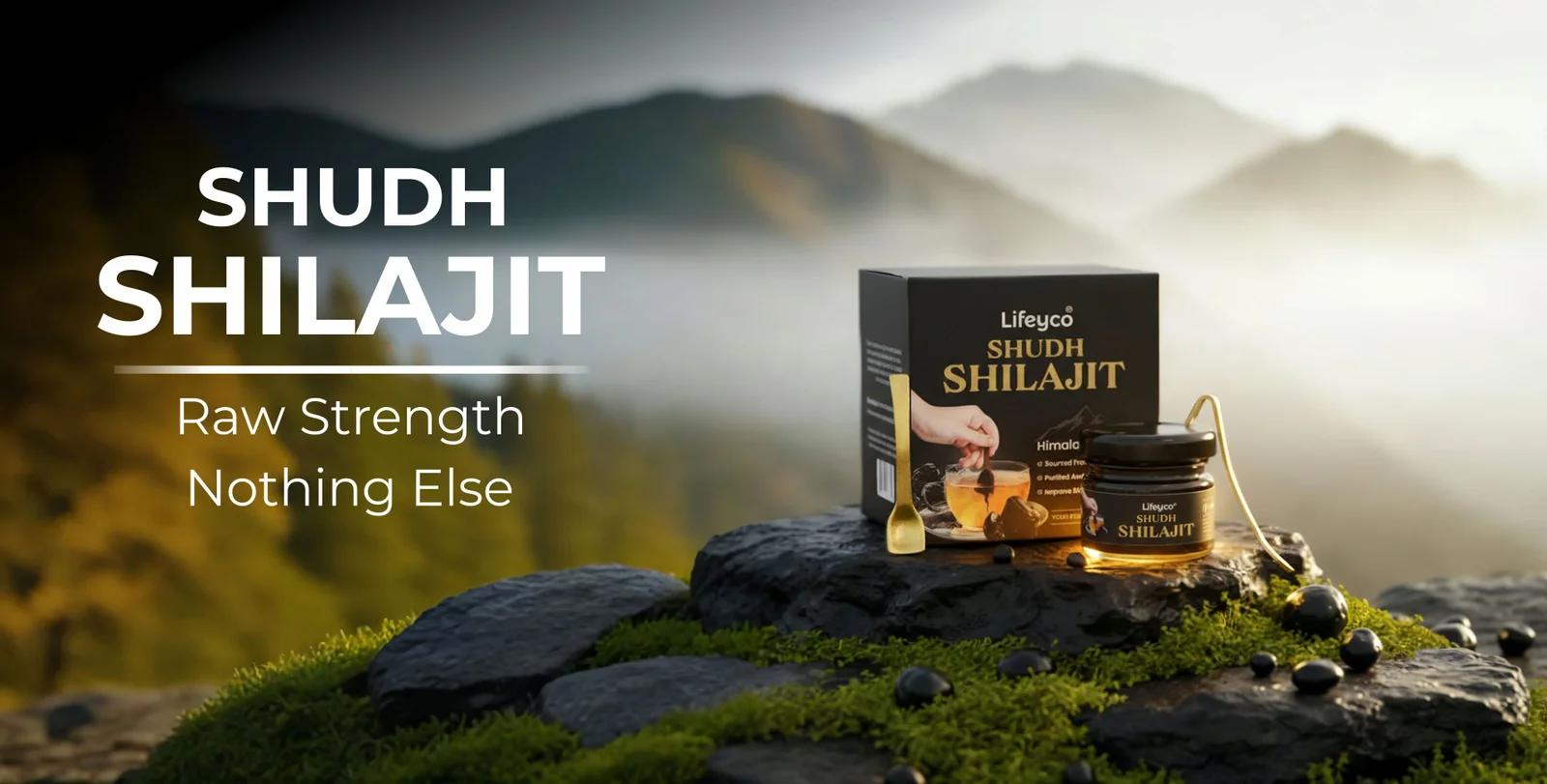
Shilajit Resin — The Most Potent Form
Shilajit resin is the closest you can get to the natural, raw form of this Ayurvedic substance. After it is harvested from high-altitude Himalayan rock faces, quality resin goes through a purification process — repeated soaking, filtering, and concentration — to remove heavy metals, grit, and contaminants. What you are left with is a dense, semi-solid, tar-like substance that is minimally processed and retains its full spectrum of trace minerals, fulvic acid, and dibenzo-alpha-pyrones.
Because resin is not subjected to spray drying or high-heat processing (which can damage heat-sensitive compounds by up to 30%), it preserves its mineral composition far better than powders or capsules. When dissolved in warm water or milk, it begins breaking down immediately — meaning faster absorption rate into the bloodstream and a stronger, quicker effect.
How to Use Shilajit Resin
Scoop a pea-sized portion (approximately 300–500 mg) using a small spoon or toothpick. Dissolve it in warm water or warm milk (not boiling — temperatures above 70°C can degrade fulvic acid). Drink it in the morning on an empty stomach, or before physical activity for best results. Do not microwave the resin jar directly.
Shilajit Capsules — The Most Convenient Form
Shilajit capsules are made by taking purified Shilajit resin or extract, drying it into a powder, and encapsulating it in a gelatin or vegetarian (HPMC) shell. For most people living busy modern lifestyles, capsules are the most practical way to take Shilajit daily — no measuring, no taste, no preparation. Just take one or two with warm water, and you are done.
The trade-off is processing. To convert sticky resin into free-flowing powder, manufacturers use drying methods — most commonly spray drying, which exposes the Shilajit to heat between 80–150°C. This process can reduce fulvic acid concentration and degrade some heat-sensitive compounds. Premium capsule brands use freeze drying instead, which preserves more of the active content. Always check which drying method your brand uses before purchasing.
Another thing to watch: many capsules include excipients and fillers — starch, maltodextrin, magnesium stearate — to improve powder flowability during manufacturing. These reduce the percentage of actual Shilajit per capsule. Read the supplement facts panel carefully and always look for batch-specific lab test certificates (COA) before buying.
Looking for the Best Shilajit Capsules in India?
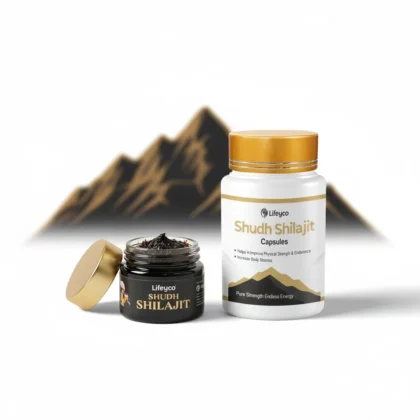
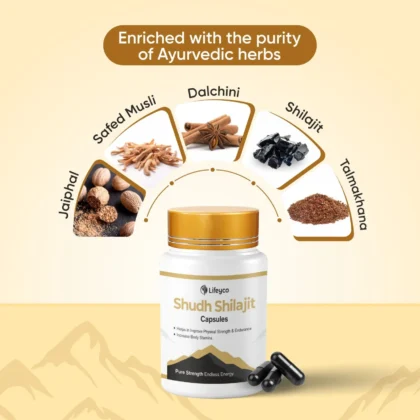
Lifeyco Shudh Shilajit Capsules combine purified Himalayan Shilajit with Safed Musli, Kaunch Beej, and Akkarkara — four Ayurvedic actives in one capsule. Lab tested, no fillers, Shodhana-purified Shilajit.
First order? Use code WELCOME10 for extra 10% off
Shilajit Powder — The Flexible Middle Ground
Shilajit powder is produced by drying purified resin and grinding it into a fine, free-flowing extract powder. It sits between resin and capsules in terms of both potency and convenience. Because drying does reduce some of the volatile bioactive compounds, Shilajit powder is generally less potent than resin — but it does give you more versatility in how you consume it.
Many people mix Shilajit powder directly into warm milk, smoothies, protein shakes, or herbal tea. This makes it a flexible option for those who want to incorporate Shilajit into their existing supplement routine without taking additional capsules. However, the quality of Shilajit powders varies significantly — some are high-quality extracts with standardized fulvic acid percentages, while others use Shilajit as a minor “label feature” with very small actual amounts per serving. Always verify the label carefully.
What Determines Shilajit Quality — Regardless of Form
Whether you choose resin, capsules, or powder, the following factors determine whether the Shilajit you are buying will actually work:
Avoid any Shilajit product that does not disclose its fulvic acid percentage, sourcing altitude, or purification process. Very cheap Shilajit (under ₹100) often skips heavy metal testing entirely — raw, unpurified Shilajit can contain lead and arsenic at unsafe levels. Always buy lab-tested, Shodhana-purified Shilajit from a brand that publishes its Certificate of Analysis (COA).
Which Form of Shilajit Is Best for You?
There is no single best form of Shilajit for everyone. The right choice depends on your lifestyle, health goals, and how consistent you can realistically be. Here is a simple breakdown:
- Maximum potency is your priority
- You follow an Ayurvedic lifestyle
- You prefer the traditional, natural form
- You do not mind the taste and prep
- You want the highest fulvic acid content possible
- You have a busy daily schedule
- You travel frequently
- You want tasteless, hassle-free supplementation
- You need consistent daily dosing
- You want a multi-herb formula for men’s health
- You regularly make smoothies or protein shakes
- You want to stack Shilajit with other supplements
- You prefer mixing into Ayurvedic drinks
- You want flexible dosing control
Shilajit Resin vs Capsules — Bioavailability Explained
One of the most commonly debated questions is whether Shilajit bioavailability is truly significantly different between resin and capsules. Here is what the evidence and practitioner experience suggests:
Resin dissolved in warm liquid begins breaking down before it even reaches your stomach. The fulvic acid is already in solution, which means faster absorption into the bloodstream. Users typically report feeling the energy effect sooner — often within 20–30 minutes.
Capsules require more steps before absorption begins. Your digestive system must first break down the capsule shell (gelatin or vegetable cellulose), then rehydrate the dry powder, then begin absorbing the dissolved compounds. This adds time to the process — typically 45–60 minutes before peak absorption. Additionally, if the capsule contains starch-based fillers, these compete with Shilajit for space without adding any benefit.
However, it is important to note that the form you actually take consistently every day will always outperform the form you take inconsistently. A high-quality Shilajit capsule taken daily for 30 days will deliver better outcomes than resin that sits in your drawer because you find it too inconvenient. Consistency matters more than form.
Resin (sublingual or warm liquid) → Resin (warm water) → Powder → Capsules (freeze-dried) → Capsules (spray-dried) → Gummies. But remember: the form you consistently use always beats the form you don’t.
Shilajit Capsules with Ayurvedic Herbs — Is It Worth It?
Many Shilajit capsule brands — including Lifeyco, Dabur, and Kapiva Gold — combine Shilajit with complementary Ayurvedic herbs. This is not just a marketing gimmick. For specific goals like testosterone support, stamina improvement, and male vitality, a synergistic multi-herb formula can deliver meaningfully better results than single-ingredient Shilajit alone.
- Safed Musli — Boosts libido, supports sperm quality, and improves physical stamina. Often called Indian Ginseng.
- Kaunch Beej (Mucuna Pruriens) — Raises dopamine and growth hormone. Supports testosterone levels and sperm motility.
- Ashwagandha — Powerful adaptogen. Reduces cortisol, supports testosterone, and reduces fatigue.
- Akkarkara — Traditional Ayurvedic nerve tonic. Improves nerve function and sexual performance.
For men specifically targeting energy, gym performance, testosterone, and male sexual wellness — a capsule combining Shilajit with these herbs represents significantly better value than single-ingredient resin at a comparable price point.
How to Take Shilajit for Best Results — All Three Forms
Shilajit Resin Dosage
Take a pea-sized portion (300–500 mg) once daily. Dissolve in warm water or warm milk at approximately 65°C. Best consumed in the morning on an empty stomach or 30 minutes before exercise. Do not exceed 500 mg per day without medical guidance. Start with a smaller rice-grain portion for the first two weeks.
Shilajit Capsules Dosage
Most brands recommend 1–2 capsules per day with warm water or warm milk. Take in the morning (on empty stomach or with breakfast) and optionally once at night before sleep. Always follow the specific brand’s dosage instructions. Do not exceed the recommended daily dose. Consistency over 4–8 weeks is more important than high dosage.
Shilajit Powder Dosage
Standard serving is 300–500 mg per day, measured using a small measuring scoop or 0.01g jewelry scale. Mix into warm (not hot) milk, water, or a smoothie. Avoid adding to boiling liquids as heat can degrade fulvic acid. One serving daily is typically sufficient for most adults.
Most people notice subtle improvements in energy and focus within 1–2 weeks of consistent Shilajit use. More significant benefits — stamina, recovery, testosterone support — typically become visible after 4–8 weeks of daily supplementation. Shilajit is not an instant fix; it is a traditional Rasayana that works cumulatively over time.
Shilajit Capsules vs Resin — Price Comparison in India
| Product Type | Typical Price Range | Supply Duration | Per Day Cost | Best For |
|---|---|---|---|---|
| Pure Resin (20g jar) | ₹800–₹2,500 | 30–60 days | ₹15–₹45/day | Maximum potency seekers |
| Multi-herb Capsules (30 caps) | ₹549–₹699 | 15–30 days | ₹18–₹45/day | Best value + formula |
| Single-herb Capsules (30 caps) | ₹300–₹1,300 | 15–30 days | ₹10–₹43/day | Basic daily supplementation |
| Shilajit Powder (30g) | ₹400–₹1,000 | 30–60 days | ₹7–₹17/day | Budget, flexible mixing |
Lifeyco Shudh Shilajit Capsules — Best Value Multi-Herb Formula
Shodhana-purified Himalayan Shilajit + Safed Musli + Kaunch Beej + Akkarkara. No fillers. Lab tested. 30 capsules at India’s most competitive price for a 4-herb formula.
New customer? Use code WELCOME10 for 10% off your first order
Our Final Take — Which Form Should You Choose?
After comparing all three forms of Shilajit on purity, processing, bioavailability, convenience, and cost — here is the honest summary:
- Resin wins on potency and fulvic acid content. Best for those who want maximum effectiveness and follow a consistent Ayurvedic routine.
- Capsules win on convenience, consistency, and versatility. Best for busy individuals who need a reliable daily supplement without any preparation hassle — especially multi-herb formulas for men’s health goals.
- Powder wins on flexibility and stacking. Best for those who already mix supplements into drinks and want to incorporate Shilajit into their existing routine.
For most people in India today — especially those targeting energy, stamina, testosterone, and gym recovery — high-quality Shilajit capsules with a multi-herb Ayurvedic formula offer the best real-world results. They are taken consistently, they are convenient, and when combined with the right herbs, the synergistic effect surpasses what plain resin alone can deliver for specific health goals.
👉 Try Lifeyco Shudh Shilajit Capsules — ₹549 only → | Use code WELCOME10 for 10% off
Disclaimer: This article is for informational and educational purposes only. It does not constitute medical advice. Always consult a qualified healthcare professional before starting any new supplement, especially if you have a medical condition, are pregnant, or are on prescription medication. Individual results may vary. Lifeyco Shudh Shilajit Capsules are a dietary supplement and are not intended to diagnose, treat, cure, or prevent any disease.
FAQ
Is shilajit resin better than capsules?
Shilajit resin has higher fulvic acid content (60–80%) and better bioavailability compared to capsules (20–50%) because it undergoes minimal processing and dissolves directly in liquid. However, capsules are significantly more convenient, tasteless, and easier to take consistently every day. For maximum potency, choose resin. For practical daily use, quality capsules deliver excellent results — especially multi-herb formulas that combine Shilajit with complementary Ayurvedic actives.
Which form of Shilajit is best for gym performance and stamina?
For gym performance, both resin and quality capsules work well. Resin gives faster absorption and a stronger initial effect. If you choose capsules, look for a multi-herb formula that combines Shilajit with Safed Musli and Kaunch Beej — these synergistic herbs significantly amplify the stamina and recovery benefits for active individuals. Take your dose 30–45 minutes before your workout for best results.
How long does Shilajit take to show results?
Most people notice improvements in energy and mental clarity within 1–2 weeks of consistent daily use. Significant benefits — better stamina, recovery, and testosterone support — typically appear after 4–8 weeks. Shilajit is a traditional Ayurvedic Rasayana that works cumulatively. Consistency matters far more than the size of individual doses. Daily intake for at least 30 days is recommended before evaluating results.
Can I take Shilajit capsules every day?
Yes. High-quality, lab-tested Shilajit capsules are generally safe for daily use within recommended dosage limits — typically 1–2 capsules per day with warm water or milk. Always choose products that disclose their purification process (Shodhana) and provide third-party COA certificates for heavy metal safety. Consult a healthcare professional if you are pregnant, breastfeeding, or have a chronic medical condition before starting supplementation.
What is the difference between Shilajit extract and raw Shilajit?
Raw Shilajit is the unpurified substance harvested directly from rocks — it can contain heavy metals, grit, and contaminants and should never be consumed directly. Purified Shilajit (resin) has been cleaned through water purification and filtering. Shilajit extract refers to a concentrated form, often standardized for a specific fulvic acid percentage, used in capsules and powders. Extract quality varies significantly — always check the fulvic acid percentage and look for COA documentation.
Which Shilajit brand is best to buy in India in 2026?
For the best combination of value, formula, and ingredient quality — Lifeyco Shudh Shilajit Capsules at ₹549 leads the field. It is one of very few brands in India that combines Shodhana-purified Himalayan Shilajit with Safed Musli, Kaunch Beej, and Akkarkara in a single capsule at this price. For pure single-ingredient Shilajit at a trusted brand name, Himalaya remains a reliable budget option. For premium resin, Upakarma and Rasayanam are well-regarded choices.